

1. Introduction — Why the Traditional Model Is Wrong
For more than 30 years, most professionals in the posture industry have repeated the same narrative:
“Posture is multifactorial.”
“Everything affects everything.”
“There are descending and ascending causes.”
Because posture is a “complex system,” they claim, no single origin can be identified.
This argument is seductive — it sounds scientific, humble, and holistic.
But in reality, it is a consequence of not understanding biomechanics.
The result?
A chaotic list of supposed causes:
- eyes
- feet
- pelvis
- knees
- intestines
- tongue
- psyche
- emotions
- trauma memories
- earwax
This “everything causes posture” theory fails mechanically, neurologically, and clinically.
Modern biomechanical research shows that:
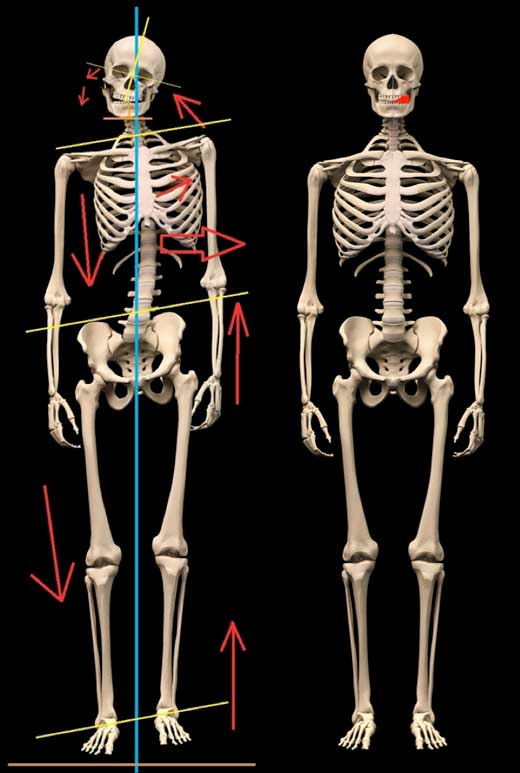
**Postural deviations follow a predictable descending cascade starting at the skull–jaw–cervical complex.
Not from the feet, pelvis, or knees.**
2. Why the “Ascending Causes” Theory Fails Biomechanically
To claim that feet, knees, or intestines cause postural collapse, a system must meet one condition:
A lower structure must influence the stability of a higher structure. But biomechanics doesn’t work this way.
Rule 1 — The skull dictates the body’s primary alignment.
Because the brain must keep the eyes level with the horizon (vestibulo-ocular reflex), the spine adapts upward to downward, not the opposite.
Rule 2 — The mandible provides part of the skull’s vertical support.
If vertical occlusal dimension collapses, the skull tilts, and the spine follows.

Listen to the AI Podcast from this article
This podcast is generated from the article to make this content more enjoyable. For those who prefer listening over reading lengthy texts, this format offers a more enjoyable way to engage with the content.
Rule 3 — The spine compensates to protect neural and respiratory function.
This produces thoracic torsion, rib-cage rotation, pelvic tilt, and functional leg-length discrepancies.
The chain is:
Skull → C0–C2 → cervical spine → thorax → diaphragm → pelvis → legs → feet
Never the reverse.
This is why:
- flat feet do not cause scoliosis
- pelvic obliquity is not a primary cause
- knee valgus is a reaction, not an origin
- digestive issues do not initiate spinal curvature
They may worsen symptoms, but they cannot initiate the cascade.
3. Why Most “Postural Experts” Get This Wrong
Most clinicians are trained to look at effects, not origins.
So when they see:
- a tilted pelvis
- collapsed arches
- knee misalignment
- asymmetrical gait
they incorrectly assume these are causes of the problem.
In reality, these are compensations created downstream from the cranio-mandibular system. Typical misinterpretation pattern:
Effect: pelvic tilt
Misinterpretation: “Your pelvis is the cause of your scoliosis.”
Reality: pelvis rotated because the skull lost symmetrical support.
Effect: knee valgus
Misinterpretation: “Your knees created your posture problems.”
Reality: knees collapse because the spine is redistributing load asymmetrically.
Effect: pronated foot
Misinterpretation: “Your feet are causing your posture issues.”
Reality: feet compensate for leg-length and pelvic rotation — both secondary.
4. The Only True Mechanical Origin: Cranio-Mandibular Imbalance
The entire postural chain depends on how the skull is supported.
Specifically:
- the vertical occlusal dimension (VOD)
- mandibular symmetry
- atlas (C1) orientation
- cranIO-cervical alignment
If this top structure collapses, the rest of the body must compensate.
What happens when the skull loses support?
- Skull tilts or sinks
- Atlas rotates
- Cervical curve adapts
- Thorax twists
- Rib cage deforms
- Diaphragm becomes asymmetric
- Pelvis tilts
- One leg becomes functionally shorter
- Feet redistribute pressure
- Muscles overcompensate
This is the descending postural chain.
And it begins only at the skull–jaw–cervical junction.
5. Why Dental Work Can Trigger Postural Collapse
Most people underestimate how powerful occlusion is.
Even a small change — such as:
- excessive molar filing
- molar intrusion
- uneven prosthetics
- asymmetrical veneers
- dental extractions
- incorrect orthodontic adjustments
can reduce or distort the skull’s vertical support.
When that happens:
- the skull collapses by millimeters
- C1 rotates
- the entire spine adapts
- facial asymmetry worsens
- posture declines progressively
This is not alternative science.
It is basic mechanical load distribution.
6. What About the Eyes, Ears, Feet, Tongue, or Psychology?
These systems influence:
- balance
- comfort
- proprioception
- symptoms
…but not structural alignment.
They modulate posture reactions, but they do not initiate structural deformities.
Examples:
Eyes
Control gaze, not skeletal load.
Ears
Affect equilibrium, not spinal architecture.
Feet
Absorb ground reaction forces, they don’t organize the spine.
Tongue
Affects swallowing, not cranio-mandibular geometry.
Psychology**
Regulates tension and behaviour, not bone position.
These are modifiers, not causes.
7. When You See “Ascending Causes,” You Are Seeing Misinterpreted Effects
Everything below the skull is reactive.
That includes:
- knees
- hips
- pelvis
- feet
- even gait cycle
They are adjusting to preserve one goal:
Keep the eyes level with the horizon
and keep the skull balanced at all costs.
This is why the lower body twists, collapses, rotates, stiffens, or compensates.
Not because it triggers the collapse, but because it is forced to adapt.
8. The Modern Biomechanical Model: Why Posture Is Strictly Descending
The human body organizes posture using hierarchical control, not random multifactorial chaos.
The hierarchy is:
- Skull
- Jaw (mandibular support)
- Upper cervical spine (C0–C2)
- Thoracic mechanics
- Diaphragm
- Pelvis
- Legs
- Feet
A structure can only influence what is below it in this chain.
Therefore, ascending influences are mechanically impossible because:
- feet cannot reposition the skull
- pelvis cannot neutralize C1 rotation
- knees cannot correct cranial tilt
- intestines cannot decompress the cervical junction
Symptoms may ascend.
Causes do not.
The skeletal architecture follows gravity and neurology, not guesswork.
9. How the Descending Chain Works (Step-By-Step Breakdown)
This is the predictable sequence seen in hundreds of biomechanics studies:
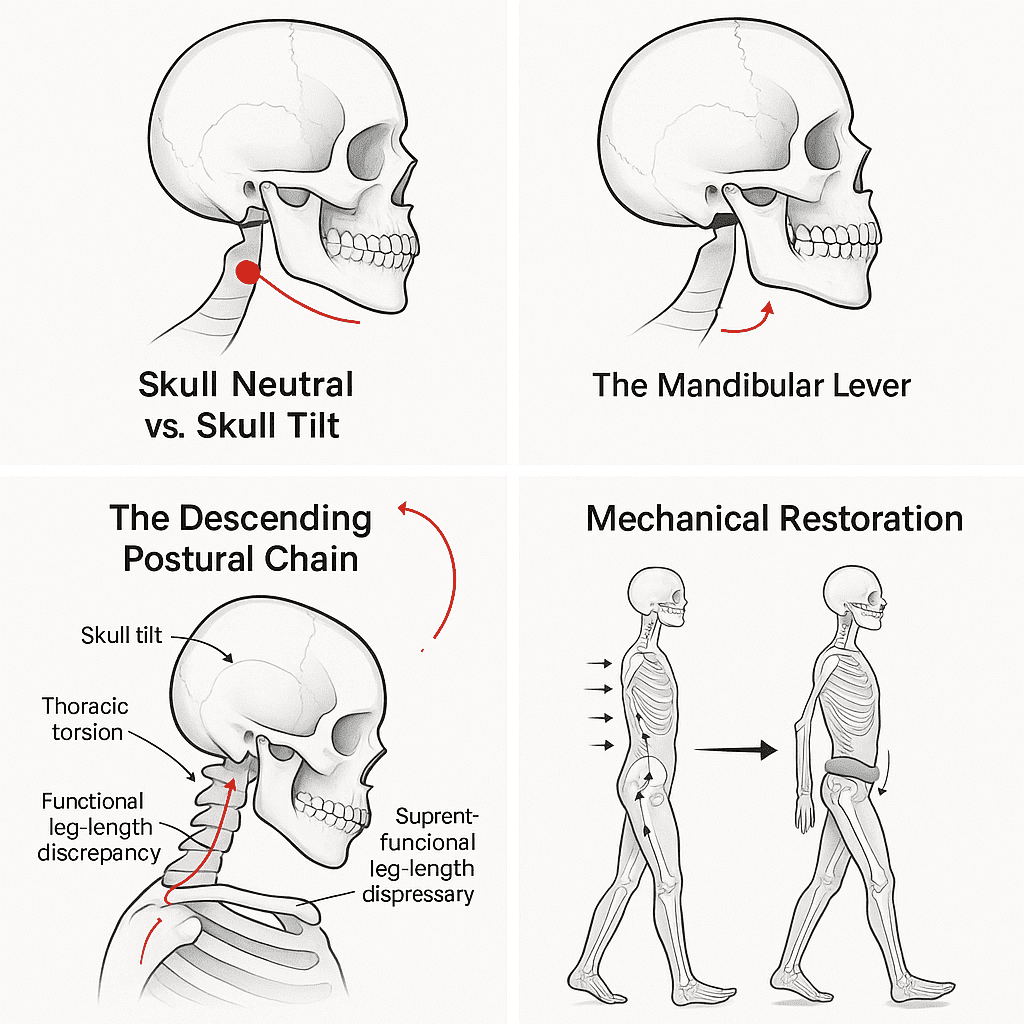
STEP 1 — Skull Tilt (The Origin)
Caused by:
- reduced vertical occlusal dimension
- mandibular asymmetry
- uneven molar support
- cranio-mandibular imbalance
Even 1 mm of VOD loss changes cranial inclination.
STEP 2 — C1 and C2 Rotate to Keep the Eyes Level
The vestibulo-ocular reflex forces this compensation.
STEP 3 — Thoracic Spine Twists
Rib cage deforms to maintain equilibrium under the shifted head.
STEP 4 — Diaphragm Becomes Asymmetric
Leading to uneven breathing patterns and increased muscular tone.
STEP 5 — Pelvis Rotates and Tilts
The pelvis re-centers the displaced upper mass.
STEP 6 — Functional Leg-Length Discrepancy Appears
One leg becomes “shorter” because the pelvis is now oblique.
STEP 7 — Foot Pressure Becomes Uneven
Pronation, supination, and arch collapse are effects, not causes.
This descending pattern is documented in:
- Journal of Oral Rehabilitation (2021)
- Frontiers in Physiology (2023)
- Clinical Biomechanics (2022)
- Frontiers in Human Neuroscience (2022)
- Harvard Health Publishing (2023)
10. Why “Ascending Causes” Seem Real — but Are Not
Professionals often misinterpret compensations as origins because compensations show visible symptoms.
Feet look collapsed → diagnosis: foot-origin posture
Wrong.
Feet collapsed because the pelvis rotated.
Pelvis looks misaligned → diagnosis: pelvic origin
Wrong again.
Pelvis misaligned because the thorax twisted.
Knee valgus → diagnosis: knee-origin posture
Incorrect.
Knees collapse because the skull shifted load asymmetrically.
This logical error is known as mistaking effect for cause, a classic biomechanical fallacy.
11. Dental Work and Posture: A Critical Relationship
Dental interventions can unintentionally alter cranial support:
Examples:
- excessive molar filing
- asymmetric veneers
- contouring
- extractions
- orthodontic over-intrusion
- prosthetic misalignment
Effects:
- skull loses height
- head tilts
- C1 rotates
- spinal compensation cascade begins
This explains why many people report:
- sudden posture deterioration
- facial asymmetry
- chronic neck tensionafter dental procedures.
This is not psychosomatic.
It is mechanical load redistribution.
12. Case Study — Why the Origin Is Always Descending
Subject:
Male, 32 — mild scoliosis, chronic neck tension, lower back pain.
Initial Examination:
- forward head posture
- 3° skull tilt
- asymmetrical molar height
- left rib-cage compression
- pelvic rotation
- 5 mm functional leg-length discrepancy
- right foot pronation
Traditional Interpretation:
“Pelvis rotated → scoliosis.”
“Foot pronation → misalignment.”
Actual Biomechanical Interpretation:
Skull tilt caused everything below it.
The pelvis, foot, and knees were simply compensating.
13. Why the Craniomandibular System Is the Primary Driver
Reason 1 — It Supports the Skull
The skull (5–6 kg) sits on a narrow contact area.
Most of its support depends on:
- molar height
- symmetry
- mandibular geometry
Reason 2 — It Controls C0–C2 Orientation
Even slight mandibular variation alters:
- suboccipital tension
- deep cervical flexor activity
- atlas orientation
Reason 3 — It Determines Thoracic and Pelvic Distribution
When the skull tilts:
- thorax twists
- diaphragm changes shape
- pelvis shifts
- gait changes
- feet compensate
Nothing upward can override this.
14. Myths Debunked by Modern Biomechanics
❌
Myth 1: Flat feet cause bad posture.
✔️ Reality: feet compensate for pelvic rotation.
❌
Myth 2: The pelvis is the root of scoliosis.
✔️ Reality: pelvis rotates because thorax and skull compensations force it to.
❌
Myth 3: Strengthening the core corrects posture.
✔️ Core strength helps stability, but cannot reposition the skull.
❌
Myth 4: Psychological states create structural deviations.
✔️ They influence tension, not mechanical alignment.
❌
Myth 5: The body has both ascending and descending causes.
✔️ Only descending causes initiate structural posture changes.
15. FAQ
1. What is the true cause of postural problems?
Mechanical imbalance at the skull–jaw–cervical junction.
2. Do feet or pelvis shape posture?
They respond to upper-body misalignment; they don’t initiate it.
3. Why do many professionals claim posture is multifactorial?
Because they observe compensations, not origins.
4. Can dental work affect posture?
Yes — if it alters vertical occlusal dimension or mandibular symmetry.
5. Why does posture collapse over time?
Because the skull loses stable vertical support, forcing compensatory adaptations.
16. Conclusion — There Is Only One True Origin
The human postural system is not chaotic.
It is hierarchical and predictable.
If the skull loses symmetrical support,
the entire body compensates downward.
Thus:
- knees are not causes
- pelvis is not a cause
- feet are not causes
- intestines are not causes
- psychology is not a cause
These are all secondary reactions.
The primary cause is cranio-mandibular imbalance — the only structure mechanically capable of initiating structural postural deviation.
Posture is descending.
Always.
17. References
Influence of occlusal contact on cervical muscle activity during submaximal clenching
https://pubmed.ncbi.nlm.nih.gov/15140166/
Examination of the relationship between mandibular position and body posture
https://pubmed.ncbi.nlm.nih.gov/17983123/
Mandibular deviations in TMD and non-TMD groups related to head posture
https://pubmed.ncbi.nlm.nih.gov/11314215/
Relationship between mandibular deviation and ocular focusing / head posture
https://pubmed.ncbi.nlm.nih.gov/14969372/
Neuromuscular dentistry: occlusal diseases and posture (PMC)
https://pmc.ncbi.nlm.nih.gov/articles/PMC3941922/
Occlusal interferences: influence on temporomandibular dysfunction and postural disorders (PMC)
https://pmc.ncbi.nlm.nih.gov/articles/PMC2948734/