
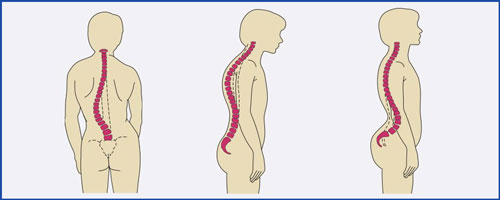
1.Why “Exercise-Based Correction” Rarely Works ⚠️
Most people with hyperlordosis or hyperkyphosis are told the same thing:
- “Strengthen your core.”
- “Stretch your chest.”
- “Mobilize your thoracic spine.”
- “Do postural gymnastics.”
- “Train 2–3 times per week for 12 weeks.”
These suggestions sound logical…
…but modern biomechanics shows they rarely produce structural change.

Listen to the AI Podcast from this article
This podcast is generated from the article to make this content more enjoyable. For those who prefer listening over reading lengthy texts, this format offers a more enjoyable way to engage with the content.
👉 Reason:
Exercises act on muscles, while spinal curves are governed by the mechanical load coming from above — specifically the skull, the jaw, and the cervical spine.
What the scientific literature actually shows:
A major systematic review (PMC6488071) concludes:
- ✔️ Thoracic kyphosis can improve slightly with exercises
- ❌ Lumbar lordosis does not improve significantly
- ✔️ Long-term structural change is not demonstrated
- ✔️ Evidence is inconsistent and low-quality
In simple terms:
Exercises improve comfort, not structure.
Why?
Because the spine cannot straighten if the skull is sinking downward due to reduced molar/premolar vertical support.
Muscles cannot override skeletal mechanics. 💀➡️🦴
2. The Real Reason the Spine Collapses 🧩
Hyperlordosis (excessive lumbar curve) and hyperkyphosis (excessive thoracic curve) follow a predictable mechanical logic:
When the skull drops even 1–2 mm…
➡️ C1–C2 rotate
➡️ Cervical extensors overload
➡️ Thoracic spine compensates by rounding
➡️ Lumbar spine compensates by increasing lordosis
➡️ Sacrum tilts anteriorly
➡️ Muscles fire asymmetrically
This is known as the descending biomechanical chain.
Primary drivers:
- Loss of posterior dental height
- Cranio-mandibular imbalance
- Skull tilt
- Reduced vertical dimension
- Maxillary/palatal asymmetry
- Chronic clenching or bruxism
- Dental over-intrusion from orthodontics
These factors alter the mechanical scaffolding of the skull, which should sit on two equal pillars:
➡️ right dental arch
➡️ left dental arch
If one arch loses height, the skull collapses downward on that side.
The spine is then forced to twist, bend, and compensate.

3. Why Exercises Fail Biomechanically 🏋️♂️❌
Reason 1 — The spine has no space to elongate
If the skull sinks, the cervical spine compresses.
A compressed cervical spine → compressed thorax → compressed lumbar spine.
Trying to “stretch” a compressed system is like trying to pull a rope tied to the ceiling.
The force can’t go anywhere.
No space = No structural change.
Reason 2 — Muscle activation follows bone position
Muscles react after the skeletal architecture has changed.
- You cannot stretch your way out of structural compression.
- You cannot “strengthen” away a skull–jaw imbalance.
Reason 3 — Compensation overrides effort
Even perfect exercises cause the body to compensate:
- Thoracic exercises → cervical compensations
- Lumbar strengthening → pelvic torsion
- Stretching → temporary relief, zero structural change
Reason 4 — Exercises never change cranial tilt
Cranial tilt of 1–3° is enough to generate:
- thoracic rotation
- lumbar extension
- anterior pelvic tilt
- muscle asymmetry
- asymmetrical gait
Exercises do nothing to reposition the skull.
4.The Key Discovery in Modern Biomechanics 🔬
The skull does not rest solely on the atlas (C1).
It also rests on the posterior dental vertical dimension (premolars + molars).
This is the missing piece in 99% of postural models.
Skull Support = Right molars + Left molars + C1–C2
If the dental support is reduced or asymmetric:
- The jaw shifts
- The skull rotates
- The vertebrae twist
- The thorax collapses
- The pelvis tilts
- The lumbar curve exaggerates
- The thoracic curve increases
This explains why people with stable cranio-mandibular mechanics can have terrible habits but perfect posture, while others gym-train for years with no change.

5. Understanding “Biomechanical Space” 📏
For the spine to elongate, it must have room to lengthen.
Postural exercises attempt to pull the spine downwards or backwards.
But the real space is created upwards, at the skull.
If the skull is lifted:
- The cervical spine decompresses
- Thoracic kyphosis relaxes
- Lumbar lordosis reduces
- Paraspinal muscles calm down
- Pelvic alignment improves
This upward lift depends on molar height and mandibular mechanics, not muscles.
6. The Mandible as a Lever ⚙️🦷
This is the central anatomical principle:
The mandible can function as:
- a third-class lever (weak, unstable)
- or as a first-class lever (strong, stable, supportive)
When posterior dental height is insufficient:
➡️ The jaw operates as a weak third-class lever
➡️ The skull collapses
➡️ The spine compresses
➡️ Hyperkyphosis/lordosis worsen
When posterior vertical dimension is restored:
➡️ The mandible becomes a first-class lever
➡️ The skull is elevated
➡️ The spine decompresses
➡️ Curves reduce naturally
This is why any approach that ignores the skull–jaw mechanics is doomed to fail.
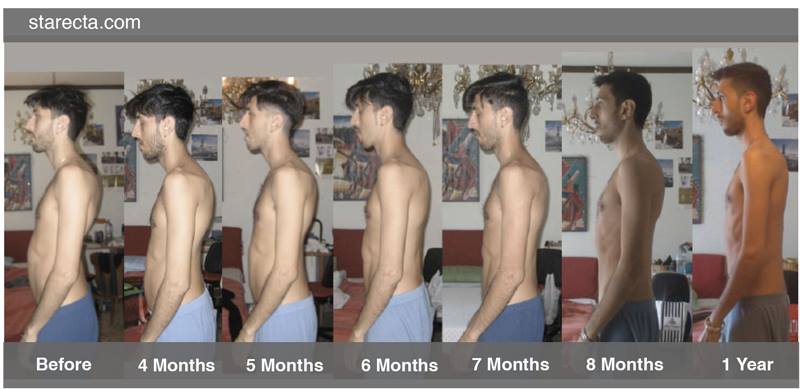
7. Why People With Hyperlordosis Feel “Blocked” 🧱
Most describe a similar sensation:
- “I try to stand straight but something stops me.”
- “When I straighten the thorax, my neck collapses.”
- “When I reduce lordosis, something pulls me forward.”
- “I can’t keep my chest open even if I stretch every day.”
This is not muscular weakness.
It’s mechanical constraint.
Cervical compression prevents the thorax from opening.
Thoracic collapse forces lumbar extension.
Lumbar extension forces anterior pelvic tilt.
The body is protecting itself.
It cannot do anything else until the skull is supported.
8. When You Should Not Rely on Exercises 🚫
Exercises are usually ineffective when the following signs appear:
Structural signs
- pronounced anterior pelvic tilt
- visible thoracic hump
- excessive lower back arch
- rib cage collapse
- forward head posture
- shoulder asymmetry
Functional signs
- chronic neck tightness
- inability to “feel” lumbar stability
- thoracic stiffness
- hypertonic lower back muscles
- asymmetrical breathing
Compensatory signs
- one leg feels longer
- foot pronation on one side
- weight always shifting to one leg
In these cases, exercises address compensation, not origin.
9. Key Principle of This Entire Article ⭐
You cannot correct hyperlordosis or kyphosis by working on the spine.
You must work on the mechanical input above the spine — the skull.
The spine is not the source of the problem.
It is the victim of the cranio-mandibular imbalance.
10. Why Only a Cranio-Mandibular Intervention Creates Upward Space 🧲⬆️
Once you understand that the spine collapses from above, the logical question is:
👉 Can we lift the skull enough to decompress the spine without exercising?
Biomechanics says yes, but only if you modify the mechanical fulcrum under the skull — the mandible.
Why the mandible is the real key:
- It sits directly under the base of the skull
- It dictates the skull’s vertical position
- It transmits mechanical forces through the cervical spine
- It determines the tension pattern of suboccipital muscles
- It governs thoracic and pelvic compensations
When the posterior teeth lack vertical height, the mandible collapses slightly upward, and the skull collapses downward.
➡️ No exercise can reverse this mechanical collapse
➡️ Only vertical support can
This is why all long-term corrections require restoring posterior dental vertical dimension.
11. The Concept of “Vertical Decompression” Explained Simply 📐
Think of your skull like a heavy book on a soft sponge.
If the sponge is thin, the book sinks.
If the sponge is thicker, the book lifts.
The posterior teeth are that support.
Add 1–3 mm of support → Skull rises → Spine decompresses.
This tiny change triggers:
- less cervical compression
- thoracic opening
- reduction of excessive lordosis
- reduced muscle hyperactivity
- improved rib-cage expansion
- improved diaphragmatic symmetry
- reduced anterior pelvic tilt
The body reorganizes itself upward.
12. How the Mandible Becomes a First-Class Lever ⚙️🦴
A fundamental Starecta insight is that the mandible can work as:
- a weak third-class lever → skull collapses
- a strong first-class lever → skull lifts
Posterior teeth act as the fulcrum.
When the fulcrum is too low (worn/short molars):
- The mandible rotates backward
- The skull drops
- The spine compresses
- Hyperlordosis and hyperkyphosis increase
When posterior vertical dimension is restored:
- The mandible rotates forward
- The fulcrum rises
- The skull lifts
- The spine decompresses automatically
This mechanical reorganization is why so many people feel immediate changes:
- lighter neck
- easier breathing
- straighter posture
- reduced lower-back tension
- better balance
No muscle activation.
No stretching.
Just biomechanics.
13. What the Biomechanical Device Actually Does 🔧
The Starecta device (neutral description, no claims) is essentially:
A calibrated lower dental splint designed to restore posterior vertical support and activate the mandibular lever.
Its biomechanical functions:
- increases molar/premolar height
- stabilizes mandibular position
- repositions the skull upward
- reduces cervical compression
- decompresses the thoracic spine
- distributes mechanical load downward symmetrically
Effects (mechanical, not medical):
- spinal lengthening
- thoracic untwisting
- reduction of excessive lumbar curvature
- more symmetrical muscular tone
- improved rib mechanics
This is pure mechanical load redistribution, not therapy.
14.What Happens Inside the Body (Step by Step) 🧬📉📈
-
Skull lifts 1–2 mm
→ cervical vertebrae decompress
→ suboccipital muscles release
-
Thoracic cage opens
→ improved rib mobility
→ better diaphragmatic descent
-
Lumbar curve unwinds
→ anterior pelvic tilt reduces
→ QL and spinal erectors calm down
-
Pelvis stabilizes
→ functional leg-length discrepancy reduces
→ gait becomes symmetrical
-
Global muscle tone reorganizes
→ less overload
→ fewer compensations
→ more efficient posture
None of these effects require “effort.”
They result from aligning the primary mechanical fulcrum.
15. Why Traditional Methods Fail (Summarized) 📝❌
Chiropractic manipulations
Temporary; do not change skull support.
Yoga / stretching
Relieves discomfort but does not decompress cervical load.
Strength training
Strengthens compensations instead of correcting origin.
Physiotherapy
Useful symptomatically, not structurally, if the skull remains low.
Braces / back supports
Increase awareness but do not influence cranial mechanics.
Pilates / core work
Improves performance, not the mechanical input.
Orthopedic insoles
Act at the bottom; the problem begins at the top.
None of them alter the cranio-mandibular vertical dimension.
Therefore none of them change structural alignment.
16. Signs That a Cranio-Mandibular Imbalance Is the Real Cause 🧠🔍
If you have hyperlordosis, hyperkyphosis, forward head posture, or persistent asymmetry, look for these clues:
Facial clues 😊
- one eye lower
- jaw deviation
- uneven cheekbones
- asymmetrical smile
- one masseter larger
Postural clues 🧍♂️
- neck always tight
- ribs rotate on inhalation
- pelvis tilted forward
- stronger arch on one foot
- uneven gait
- shoulder height mismatch
Sensory clues ⚡
- constant back fatigue
- feeling “compressed” from above
- limited thoracic expansion
- inability to maintain posture
If 3+ signs apply, the cause is almost always descending, not ascending.
17. Mini Evidence Summary 📚
Multiple peer-reviewed studies support the top-down model:
- Journal of Oral Rehabilitation (2021)
Shows occlusal asymmetry changes head–neck alignment.
- Frontiers in Physiology (2023)
Mandibular imbalance modifies global muscle tone.
- Clinical Biomechanics (2022)
Occlusal correction influences pelvic symmetry.
- Frontiers in Human Neuroscience (2022)
Diaphragm asymmetry alters cervical muscle loading.
- Spine Journal (2020)
Foot orthotics do not change spinal curves in structural scoliosis.
These studies confirm the mechanical chain described in Part 1 and 2.
18. When Spine Decompression Begins 🧩
Not medical results — purely mechanical sensations frequently described:
- neck feels lighter
- head balances effortlessly
- thorax opens during breathing
- lower back no longer “pulls forward”
- hips feel more stable
- posture becomes upright without effort
- walking becomes more symmetrical
These are normal outcomes of mechanical decompression.
Conclusion — Posture Cannot Improve From the Bottom Up 🎯
Hyperlordosis and hyperkyphosis are not muscular problems.
They are mechanical consequences of a cranio-mandibular imbalance.
Exercises:
→ strengthen compensations.
→ cannot change cranial support.
Mechanical correction:
→ reorganizes posture upward.
→ creates vertical space.
→ decompresses the spine.
→ allows curves to unwind naturally.
Understanding this shifts posture from “hard work” to biomechanical precision.
If you want further details about the Rectifier, click here