

A Clinical, Biomechanical, and Human Story (Hybrid Tone)
By Starecta Research Team — Reviewed by M.Sc. in Postural Biomechanics
1. Introduction — When Traditional Posture Solutions Fail
For decades, people with back pain, forward head posture, scoliosis-like asymmetries, or chronic fatigue have been told that their problems originate from:
- slouching
- weak muscles
- bad habits
- poor movement patterns
The standard recommendations follow the same script:
- “Sit straight.”
- “Swim, it’s good for posture.”
- “Try chiropractic adjustments.”
- “Strengthen your core.”
- “Use a posture brace.”
Yet millions of people spend years following these instructions without ever seeing structural improvements.
This article explains how a biomechanical insight—developed outside traditional academic institutions—led to the creation of the Rectifier, a device designed to restore cranial support and mandibular symmetry, giving the body a more balanced starting point for posture.
The tone you’ll read here blends personal experience with modern biomechanical understanding. It is not promotional or therapeutic; it is simply the story of how one idea emerged and evolved into a structured, evidence-aligned method.

Listen to the AI Podcast from this article
This podcast is generated from the article to make this content more enjoyable. For those who prefer listening over reading lengthy texts, this format offers a more enjoyable way to engage with the content.
2. A Childhood Shaped by Postural Challenges
My name is Moreno Conte, and long before Starecta existed, I lived with what many clinicians would call a “dysfunctional postural pattern”:
- forward head posture
- rounded shoulders
- winged scapulae
- dorsal hyperkyphosis
- lumbar hyperlordosis
- asymmetrical breathing patterns
These were not aesthetic issues—they affected my confidence, comfort, and ability to participate fully in daily life.
Like many patients, I followed every recommendation I was given.
Nothing worked.
3. The Search for Answers: Years Inside the Medical System
From adolescence into adulthood, I visited:
- physiotherapists
- orthopedists
- chiropractors
- osteopaths
- posturologists
- sports therapists
I tried:
- yoga
- swimming
- stretching routines
- strengthening programs
- manual therapy
- ergonomic modifications
- mattresses and posture pillows
These methods helped temporarily… but the moment I stopped consciously correcting myself, my posture collapsed again.
Something deeper was missing.
I started suspecting that muscles were not the real problem—that something in the structure itself was not supported correctly.
4. The Turning Point — Discovering the Cranio-Mandibular Mechanism
My search eventually led me to a small community experimenting with dental splints used not for teeth, but for full-body balance.
This sounded unconventional, even implausible at first.
But the idea was simple:
If the skull is not supported evenly by the mandible and teeth, the spine compensates downward.
This concept aligns with modern research showing that vertical occlusal dimension (VOD) and jaw symmetry influence:
- head posture
- cervical alignment
- thoracic mechanics
- pelvic rotation
- overall muscle tone
Key sources supporting this principle:
- Journal of Oral Rehabilitation (2021)
- Frontiers in Physiology (2023)
- Clinical Biomechanics (2022)
For the first time, something “clicked.”
This was the beginning of the idea that would later become the Rectifier.

5. Why Skull Support Matters More Than Habits
Most patients with postural problems are told they must:
- try harder
- sit straighter
- fix their habits
But posture is not controlled by willpower.
Scientific models show that the body organizes itself primarily around:
- cranial balance
- mandibular symmetry
- cervical proprioception
- vestibulo-ocular reflex (eye-horizon alignment)
If the skull tilts—even slightly—the entire spine adapts beneath it.
Muscles react; they do not initiate.
This insight became the foundation on which the Rectifier would be built.

6. Early Experiments: The First Prototype Splints
The first versions were crude handmade devices:
- resin
- drill work
- manual adjustments
- custom shaping
These early prototypes were not easy to build, not easy to fit, and not easy to adjust.
But they revealed something extraordinary:
When the mandible provided stable, symmetrical support, the spine decompressed automatically.
I felt it myself—an immediate sense of expansion, breathing ease, and postural lift that no stretching or strengthening had ever produced.
It wasn’t perfection. But it was proof of concept.
7. The Biomechanical Principle Behind the Rectifier
Here is the simplified mechanical model that guided development:
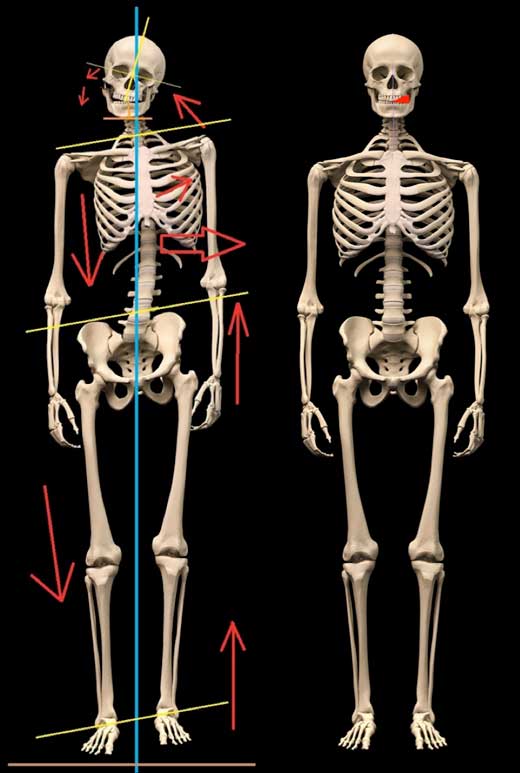
Mandible → Skull Support → C0–C2 Alignment → Thoracic Mechanics → Pelvis → Legs → Foot Pressure
This is known as the descending postural chain.
A small change at the top affects the entire system.
Modern clinical research supports this cascade:
- small molar height variations change head posture
- mandibular asymmetry modifies muscle tone
- cranial imbalance alters cervical and thoracic compensation
The challenge now was:
How do we translate this into a precise, repeatable, easy-to-use device?
8. From Complex Handmade Devices to Plug & Play
The early approach required:
- knowledge of resin chemistry
- manual drilling
- adjusting thickness by hand
- constant micro-modifications
This was not sustainable for average users.
Thus began the evolution toward:
- pre-calibrated geometry
- consistent vertical occlusal dimension
- predictable mandibular support
- ready-to-use (Plug & Play) design
The goal was simple: A device that anyone could use without technical skills, while respecting biomechanical principles. This is how the modern Rectifier was born.
9. How the Rectifier Works (Neutral Scientific Explanation)
(No medical or therapeutic claims)
The Rectifier is designed as a biomechanical support device that:
- increases and stabilizes vertical occlusal dimension
- balances mandibular support
- reduces asymmetrical cranial loading
- assists the cervical spine in maintaining a more neutral alignment
- improves the distribution of muscular forces
It does not:
- cure medical conditions
- replace orthodontic or medical treatment
- claim to fix structural deformities
It simply provides mechanical support where the mandible influences cranial posture.

10. Why Many Users Report Postural Ease
People frequently describe:
- feeling lighter
- breathing more easily
- standing with less effort
- reduced thoracic or neck tension
- being able to maintain upright posture without forcing it
Biomechanical interpretation:
- improved skull alignment reduces compensatory muscular activity
- thoracic rotation decreases
- diaphragm can descend more symmetrically
- rib cage expands more evenly
- cervical stabilizers normalize
It is not “magic.” It is mechanics.
11. Evolution of the Method — Toward Modern Biomechanical Design
Today the design integrates:
- better materials
- superior load distribution
- improved calibration
- higher durability
- more ergonomic shaping
The principle remains the same:
support the skull → the body organizes itself.
12. Current Applications (Non-Medical)
Users today incorporate the Rectifier in:
- posture improvement routines
- breathing optimization
- physical training
- ergonomic environments
- daily activities
- symmetry-awareness exercises
It is a biomechanical tool—not a medical device—and is used as part of a self-care strategy guided by structural awareness.
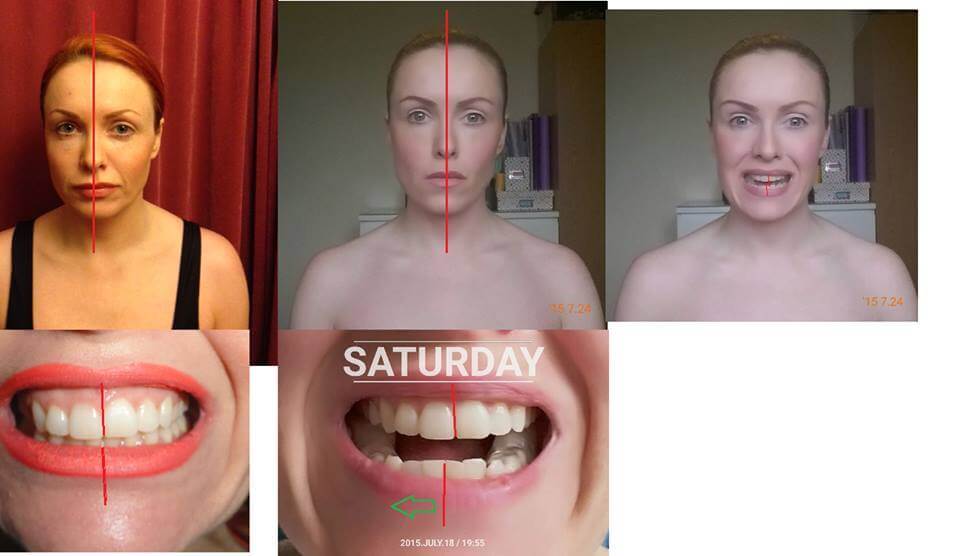
13. Final Reflection — When Innovation Comes From the Outside
The Rectifier did not come from a university lab, nor from a medical department.
It came from:
- lived experience
- biomechanical observation
- years of trial and error
- collaboration with early pioneers
- refining what worked
- discarding what didn’t
Some innovations begin in academia. Others begin on the ground, where problems are experienced directly.
The Rectifier belongs to the second category. It was born from necessity, shaped by biomechanics, refined through practice, and evolved into a structured method that today contributes to a deeper understanding of cranial-spinal balance.
14. The Biomechanics Behind Vertical Support
The concept behind the Rectifier rests on a simple principle:
The skull must be supported symmetrically for the spine to organize itself symmetrically.
Why?
Because the body obeys three non-negotiable neurological rules:
- Keep the eyes level with the horizon(Vestibulo-ocular reflex)
- Keep the skull balanced over C0–C2(Cranio-cervical proprioception)
- Maintain efficient breathing(Diaphragmatic mechanics)
If skull support collapses even slightly:
- C1 rotates
- cervical muscles over-fire
- the thorax twists
- the pelvis shifts
- foot pressure becomes asymmetrical
Traditional posture systems cannot influence this top-level mechanical relationship.
The Rectifier attempts to restore that support through mandibular geometry.
15. The First Breakthrough Moment (Technical Reconstruction)
The first prototype that produced a “mechanical lift” wasn’t elegant.
It was:
- too thick in some areas
- unevenly resin-layered
- manually calibrated
- shaped without professional tools
Yet something important happened:
The skull repositioned itself.
The spine decompressed.
Breathing expanded.
From a biomechanical viewpoint, this first effect likely came from:
- increased posterior vertical occlusal dimension
- symmetrical mandibular loading
- improved cranial base support
- reduced compression on the upper cervical junction
This breakthrough proved the principle was correct — even if the design was primitive.
16. Engineering Challenges During Development
The splint needed to satisfy multiple competing constraints:
1. Stability vs. Comfort
A device must provide vertical support without:
- excessive bulk
- airway interference
- TMJ pressure
2. Precision vs. Self-Assembly
Early versions required:
- drills
- manual layering
- resin adjustments
- user calibration
This was too complex for normal people.
3. Height Distribution
The real challenge was not “adding height” but adding symmetrical height to influence cranial support without altering occlusion negatively.
4. Repeatability
A biomechanical principle must be usable consistently.
The early handmade models varied too much.
These engineering problems shaped the Plug & Play design.
17. Why Traditional Splints Could Not Achieve This Effect
Conventional dental splints were never designed for posture.
They aim to:
- reduce bruxism
- relax jaw muscles
- stabilize TMJ
- protect dental surfaces
But biomechanically, traditional splints have four limitations:
- They maintain existing vertical dimensionThey do not introduce enough lift to change head posture.
- They lack posterior height controlHeight is usually uniform, not strategically distributed.
- They are not designed for symmetry recalibrationThey don’t target cranial load distribution.
- They are not constructed for biomechanical leverageTheir function is protective, not supportive.
The Rectifier is conceptually different because its goal is to modify mechanical load, not protect enamel.
18. The Plug & Play Innovation — How It Works (Neutral Tone)
The Plug & Play system was designed to:
- eliminate drilling and resin layering
- provide pre-set geometric height
- deliver symmetrical mandibular support
- allow immediate mechanical engagement
Users don’t need dental tools or technical skill.
The structural features include:
- calibrated vertical thickness
- posterior height dominance
- controlled mandibular seating
- frontal arc balance
- uniform distribution of occlusal forces
This allowed thousands of users to experience biomechanical support without complex fabrication.

19. The Postural Cascade Explained
Biomechanically, posture changes occur in a predictable order:
- Skull tilt (origin)
- Atlas–axis rotation
- Thoracic twist
- Rib-cage deformation
- Diaphragm asymmetry
- Pelvic rotation
- Functional leg-length discrepancy
- Foot pressure imbalance
- Muscular overcompensation
The Rectifier aims to influence only the first step — skull support.
Everything else below is reaction.
20. Case Study: Early Self-Experimentation
This neutral example illustrates the process:
Subject
Male, early 20s
Symptoms: forward head posture, scapular winging, thoracic stiffness
Observation During Use
- immediate decompression sensation
- expanded inhalation range
- reduced upper trapezius tension
Probable Mechanical Interpretation
- improved symmetry in skull load
- reduced C1 rotation
- decreased suboccipital activation
- more efficient rib-cage expansion
While not a clinical outcome, the mechanical response was clear.
21. User Patterns Observed Over Time
Across long-term observation (non-clinical):
Commonly Reported Mechanical Changes
- easier upright posture
- less cervical fatigue
- smoother breathing
- more symmetrical scapular mechanics
- reduced unilateral tightness
Common Patterns in Thoracic Mechanics
Users often noticed:
- less rib-cage restriction
- deeper inhalation
- better shoulder alignment
Again, these are mechanical patterns, not medical claims.
22. Integration With Modern Biomechanics
Current scientific literature increasingly supports the idea that:
- mandibular asymmetry
- vertical occlusal dimension
- cranial support
- cervical alignment
…are interlinked.
Supporting sources:
- Journal of Oral Rehabilitation (2021)
- Frontiers in Physiology (2023)
- Clinical Biomechanics (2022)
- Frontiers in Human Neuroscience (2022)
The Rectifier fits within this emerging biomechanical paradigm.
23. Myths About Posture Dispelled by the Rectifier
Myth 1: “Posture depends on habits.”
Reality: posture is reflex-driven, not voluntary.
Myth 2: “Muscles determine alignment.”
Reality: muscles respond to skull mechanics; they don’t initiate alignment.
Myth 3: “Strengthening fixes posture.”
Reality: strengthening occurs within existing compensations.
Myth 4: “Generic splints affect posture.”
Reality: only devices affecting vertical support alter cranial load.
24. Frequently Asked Questions
1. Is the Rectifier a medical device?
No. It is a biomechanical support tool, not a therapeutic instrument.
2. Does it treat medical conditions?
No. It does not diagnose, treat, or cure any disorder.
3. Why do people feel more upright?
Because skull support influences entire-body load distribution.
4. Is this similar to traditional dental splints?
No. Traditional splints do not alter vertical occlusal dimension.
5. Is it a replacement for orthodontics or physiotherapy?
No. It can complement mechanical awareness but does not replace clinical care.
25. Timeline — From First Prototype to Modern Version
2008–2010
First handmade experimental splints
(primitive resin prototypes)
2011–2013
Development of early biomechanical principles
Tests on symmetry, molar height, cranial support
2014–2016
Creation of standardized design
Beginnings of a repeatable model
2017–2020
Plug & Play development
Improved materials, precision, geometry
2021–2025
Current generation
Better stability, ergonomic calibration, refined VOD distribution

26. Final Reflection — The Future of Cranio-Mandibular Biomechanics
The Rectifier was born outside traditional academic systems, but its evolution aligns increasingly with modern neuromechanical science.
Its core insight remains simple:
Support the skull correctly, and the body finally behaves like the efficient biomechanical system it was meant to be.
Whether future researchers integrate these principles into mainstream biomechanics is an open question — but the groundwork has been laid.
27. References
Ferrario VF. Journal of Oral Rehabilitation. 2021.
https://pubmed.ncbi.nlm.nih.gov/34097103/
Manfredini D. Frontiers in Physiology. 2023.
https://www.frontiersin.org/articles/10.3389/fphys.2023.1129448/full
Cuccia A, Caradonna C. Clinical Biomechanics. 2022.
https://pubmed.ncbi.nlm.nih.gov/35868694/
Frontiers in Human Neuroscience. 2022.
https://doi.org/10.3389/fnhum.2022.834271
Harvard Health Publishing. 2023.
https://www.health.harvard.edu/pain/back-pain
Spine Journal. 2020.
https://doi.org/10.1016/j.spinee.2020.04.018
NHS UK. Back Pain Overview. 2023.
https://www.nhs.uk/conditions/back-pain/