

Back supports are marketed as quick solutions for posture: elastic braces, shoulder straps, lumbar belts, and even magnetic devices. Many people turn to these tools after long hours at the desk, hoping for relief. Yet despite the promise, most users notice the same pattern: mild improvement while wearing the device, collapse when it’s removed.
The reason is simple.
Back supports act on the outside. Posture is controlled from the inside.
No external brace can override the internal cranio-mandibular and cervical mechanics that actually dictate spinal alignment. ➡️
This misunderstanding causes people to waste money on supports that can only offer temporary comfort.
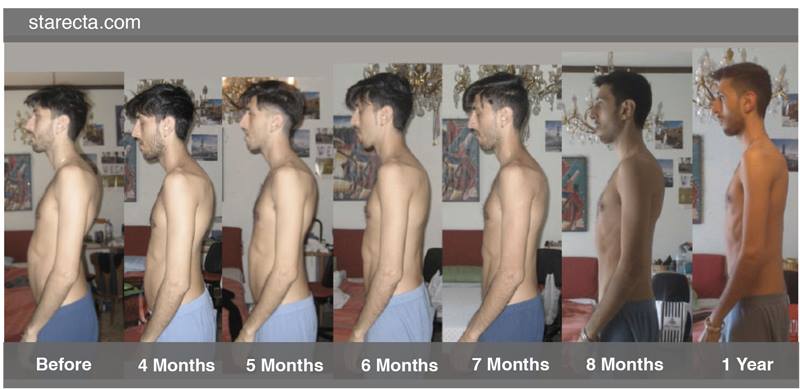
⭐ Why External Back Supports Fail (Biomechanical Overview)
These devices cannot influence the structures that control posture. Specifically, they do NOT:
- ❌ lift or stabilize the skull
- ❌ restore vertical dental height
- ❌ activate the mandibular lever
- ❌ decompress cervical vertebrae
- ❌ correct descending compensations along the spine
Instead, they simply:
- ✔ reduce muscular load temporarily
- ✔ give a short-term sense of “being straight”
- ✔ prevent slouching through external restraint
But none of these change the mechanical origin.
The Real Reason Back Supports Don’t Work
When the craniomandibular system loses balance, the skull shifts downward or laterally. Even a micro-shift (0.5–1 mm) can trigger the entire chain of compensations.
This leads to:
• cervical compression
• thoracic rotation
• rib-cage asymmetry
• pelvic tilt
• functional leg-length discrepancy
• chronic muscular tension
No external brace has the ability to influence these internal mechanisms.
This explains why people with scoliosis, kyphosis, or hyperlordosis rarely improve with supports alone. Their bodies aren’t collapsing due to weak muscles—the collapse originates higher up.
Internal vs External Support (Quick Comparison)
Feature Back Support Internal Biomechanics (Mandibular Lever)
Acts on Muscles Skull–jaw–cervical system
Duration of effect Temporary Structural / long-term
Corrects skull tilt ❌ No ✔ Yes
Decompresses spine ❌ No ✔ Yes
Prevents posture collapse ❌ Only when worn ✔ Even without external aids
When Back Supports Can Help
Back supports aren’t completely useless—they’re useless alone.
However, when combined with an internal corrective mechanism, they can provide:
- muscle relaxation
- reduction of fatigue
- support during the adaptation phase
- better comfort during long seated periods
Think of them as a secondary assistant, not a primary solution.
How Internal Biomechanics Actually Control Posture
To understand why external supports fail, you must understand how posture is mechanically generated inside the body. The key structure responsible for global alignment is the skull–jaw–cervical complex. This system dictates how the spine distributes load and how the muscles activate to keep the body upright.
When the mandible loses height or symmetry—due to dental wear, missing molar support, or cranial rotation—the skull drops slightly. This micro-collapse initiates a chain reaction that no back brace can stop.
Even a minimal decrease in vertical height can cause:
- cervical compression
- tension in suboccipitals
- increased thoracic flexion
- forward head posture
- rib cage rotation
- pelvic tilt
External supports simply “push” the body into position, but the skull continues to load the spine unevenly. It’s like trying to straighten a crooked tree by tying its branches while the trunk is still tilted.

⚙️ The Mandibular Lever Effect (Core Principle Behind Real Correction)
The mandible naturally operates like a mechanical lever supporting the skull.
But this lever only works properly if the premolar–molar zone has adequate vertical height.
When this area collapses, the mandible becomes a disadvantageous third-class lever, forcing the cervical spine to carry excessive weight.
A proper biomechanical device can restore the mandible to a first-class lever, giving the skull upward support and decompressing the spine.
What this does in real terms:
- ✔ frees the cervical vertebrae
- ✔ reopens the thoracic area
- ✔ reduces muscular tension
- ✔ straightens the shoulders naturally
- ✔ restores symmetrical load distribution
- ✔ eliminates the need for compensatory slouching
These are structural changes—far beyond anything a brace can replicate.
What Happens When the Mandibular Lever Is Reactivated
When upward support is restored, the entire postural chain begins to reorganize from the top down.
Immediate biomechanical effects:
- skull lifts and derotates
- atlas–axis decompress
- cervical curve normalizes
- thoracic tension reduces
- diaphragm becomes more symmetrical
- pelvic rotation decreases
- gait stabilizes
This is why real correction must come from inside.
Back supports only handle superficial symptoms.
When Back Supports Make Sense (But Only Combined)
Once internal support is restored, external back supports can become useful assistants in the adaptation phase. They help the body maintain comfort while the neuromuscular system integrates new signals.
They work best for:
- long computer sessions
- early adaptation phases
- preventing fatigue during rebalancing
- reducing unnecessary tension
But they cannot:
- correct scoliosis
- realign the cervical spine
- stabilize the skull
- fix pelvic asymmetry
- undo rib-cage rotation
- prevent postural collapse on their own
They should be seen as a comfort tool—not a corrective instrument.
Why Magnetic Supports Are Especially Misunderstood
Magnetic back supports are widely marketed as therapeutic, but most claims have little scientific basis. They may offer mild warmth or muscle relaxation, but:
- ❌ they do not influence spinal alignment
- ❌ they do not alter neuromuscular recruitment
- ❌ they do not affect cranio-mandibular mechanics
If you rely on them alone, you will only experience placebo-level benefits.
Used with proper internal correction, they can help reduce tension—nothing more.
Summary Table — External vs Internal Solutions
System What It Does What It Cannot Do
Shoulder Back Support Reduces shoulder load Cannot stop cervical compression
Lumbar Belt Helps with fatigue Cannot fix pelvic tilt
Magnetic Support Relaxes muscles Cannot correct skeletal imbalance
Internal Mandibular Biomechanics Corrects the skull load, decompresses spine, resets posture Needs time + adaptation
Final Insight: Why Back Supports Fail Without Internal Correction
Back supports create alignment by force, not by biomechanics.
They act after the problem has already begun.
Internal correction acts before, addressing the root cause—
the cranio-mandibular imbalance that loads the entire spine unevenly.
This is why people who rely only on external supports stay stuck.
And why those who work on internal mechanics begin to straighten naturally.