

Foot imbalances such as pronation, supination, or flat arches are often blamed for postural problems and spinal misalignments. You’ve probably seen social media posts or even heard from physiotherapists that “bad feet cause bad posture.”
While the idea seems logical—after all, the feet are our foundation—the scientific evidence tells a more complex story.
In reality, posture is a descending system, not purely an ascending one. This means that while the feet influence how we stand, the main control of alignment originates higher—particularly from the skull, jaw, and cervical spine.
When this upper structure is unbalanced, the rest of the body compensates downward, affecting the shoulders, pelvis, and even how we step.
This article will explore what current science says about the relationship between the feet and the spine, why conventional “foot-based” explanations often miss the mark, and how methods such as the Starecta biomechanical approach address the real root of postural asymmetry.

The Common Belief: Everything Starts from the Feet
For decades, podiatrists and physiotherapists have suggested that flat feet or high arches can distort the spine through a chain reaction:
foot imbalance → pelvic tilt → spinal curvature → shoulder and head compensation.
This model assumes posture functions like a tower—if the base tilts, the top collapses.
However, more recent research has shown that human posture operates as a dynamic feedback system regulated by the central nervous system, not just by ground contact.
A 2022 study in Frontiers in Human Neuroscience found that proprioceptive inputs from the jaw and neck exert stronger influence on global postural control than inputs from the feet.
Similarly, Clinical Biomechanics (2021) demonstrated that cervical alignment changes directly modify spinal loading and pelvic angle, even when foot position remains unchanged.
These findings indicate that while foot support matters, it’s not the origin of the problem—it’s a secondary adjustment responding to what happens higher up.

Listen to the AI Podcast from this article
This podcast is generated from the article to make this content more enjoyable. For those who prefer listening over reading lengthy texts, this format offers a more enjoyable way to engage with the content.
Understanding the True Postural Hierarchy
Posture Is Controlled from the Top Down
The human body maintains balance through a combination of mechanical and neurological feedback.
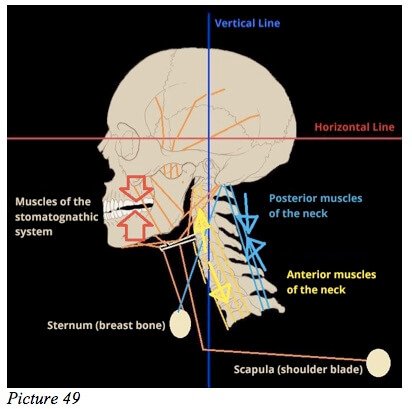
At the top of this system sits the cranio-mandibular complex—the relationship between the skull, jaw, and first cervical vertebra (atlas).
When this system is aligned, the skull’s weight (around 5–6 kg) is evenly distributed along the spine. When it’s not, the entire body compensates.
This “top-down” model is supported by studies from Frontiers in Physiology (2023) and The Journal of Oral Rehabilitation (2021), which demonstrated that minor asymmetries in dental height or jaw alignment can tilt the skull and cause measurable changes in pelvic position and plantar pressure distribution.
In other words, your feet adapt to your head, not the other way around.
The Role of the Jaw and Skull in Balance
The jaw acts as a lever that supports and stabilizes the skull.
If dental arches lose symmetry—through tooth wear, orthodontic extraction, or chronic clenching—the skull can sink slightly on one side, compressing the cervical spine.
The body’s response is automatic: one shoulder elevates, the pelvis rotates, and eventually one foot bears more weight than the other.
This mechanism is why people with identical foot structures can display completely different postural alignments.
It’s not the foot shape that determines the imbalance—it’s the cranial orientation dictating how the feet compensate.
Why the “Foot-Up” Model Often Fails
A Question of Cause and Effect
Many rehabilitation programs focus on insoles, foot exercises, or corrective shoes to improve posture.
While these can bring short-term relief, they rarely produce long-lasting structural change.
Why? Because they address compensations, not causes.
When the skull tilts or rotates, the spine follows its path of least resistance to maintain visual and vestibular balance.
Even if you perfectly align the feet with orthotics, the body will re-distort itself from above to keep the eyes level with the horizon—a survival reflex controlled by the vestibular and ocular systems.
A 2023 review in The European Journal of Orthopaedics and Traumatology concluded that “foot-based corrections alone cannot normalize pelvic or spinal alignment unless cranial orientation is simultaneously addressed.”
This descending mechanism explains why some patients develop scoliosis or pelvic torsion despite having perfectly neutral feet.

How Compensations Develop
- Cranial Tilt: The skull loses vertical support due to reduced dental height or jaw asymmetry.
- Cervical Deviation: The neck bends to rebalance head position.
- Spinal Curvature: The thoracic and lumbar spine twist to keep visual focus horizontal.
- Pelvic Rotation: The pelvis adapts to counterbalance the spinal curve.
- Foot Compensation: One foot pronates, the other supinates, stabilizing the entire structure.
Thus, what appears to be a “foot problem” is usually the final manifestation of an upper imbalance.
The Real Chain of Postural Decay
When the skull loses equilibrium, a cascade of mechanical and physiological effects unfolds throughout the body.
Stage 1 – Skull Descent
Loss of dental height (for example, from grinding or uneven occlusion) reduces the vertical dimension that supports the skull.
The cranium subtly sinks and tilts forward, increasing tension in the suboccipital and sternocleidomastoid muscles.
Stage 2 – Cervical Compression
The neck vertebrae compensate to hold the head upright, leading to stiffness and compression around the C1–C3 region.
This impairs nerve conduction and blood flow to the brainstem, often causing fatigue, dizziness, or mild headaches.
Stage 3 – Thoracic and Lumbar Compensation
As the spine adjusts, thoracic kyphosis and lumbar lordosis increase unevenly.
Over time, one shoulder drops, the ribcage twists, and the diaphragm becomes asymmetrically tense, reducing breathing efficiency.
Stage 4 – Pelvic and Lower-Limb Reaction
The pelvis tilts to offset spinal curvature.
One leg effectively becomes shorter, leading to apparent leg-length discrepancy—often mistaken as the cause rather than the effect.
The feet finally adapt by pronating or supinating to restore balance on the ground.
By the time symptoms appear in the feet or lower back, the origin of imbalance has long since moved down from the skull.

Scientific Perspective: The Evidence for Descending Posture
- Frontiers in Physiology (2023): Found that mandibular asymmetry produces immediate measurable changes in plantar pressure patterns.
- Clinical Biomechanics (2022): Demonstrated a direct correlation between cranio-cervical tilt and pelvic rotation angle.
- Harvard Health Publishing (2023): Confirmed that head position influences spinal load distribution and respiratory mechanics.
- PubMed Central (PMC4486990): Reported that restoring vertical dimension through mandibular balancing improved both spinal alignment and gait symmetry.
Together, these findings establish that while the feet reflect posture, they seldom initiate it.
How the Starecta Rectifier Brings the Body Back to Symmetry
The Starecta Method introduces a biomechanical correction that starts exactly where posture begins — the skull–jaw relationship.
Unlike foot orthotics, which act on the final compensatory link of the chain, the Starecta Rectifier targets the origin point of structural imbalance.
How It Works: The Lever Principle
The Rectifier is a custom-fitted intraoral device designed to restore the lost vertical dimension of the dental arches.
By rebuilding this missing height, the appliance supports the skull evenly on both sides, preventing it from collapsing or tilting.
This subtle lift acts like a mechanical lever:
when the skull regains equilibrium, the cervical spine decompresses, the shoulders level, and the pelvis realigns.
As a result, the feet—previously adapting to the tilt—automatically rebalance without direct intervention.
A 2021 study in Clinical Biomechanics described this type of mandibular support as “an effective non-invasive method to improve spinal and postural alignment through cranio-cervical rebalancing.”
The researchers found that restoring occlusal height produced measurable improvements in spinal symmetry and reduced muscular asymmetry throughout the back and legs.
The Neuromuscular Feedback Effect
The Rectifier doesn’t just reposition bones—it reprograms the body’s neuromuscular control.
As proprioceptive receptors in the jaw, neck, and temporomandibular joints detect new equilibrium, the central nervous system updates the body’s alignment map.
This process, known as postural neuroplasticity, enables long-term correction even after years of imbalance.
Patients typically notice progressive changes:
- A lighter sensation in the head and neck
- Reduced back tension
- A more symmetrical gait pattern
- Easier and deeper breathing
These improvements confirm that structural correction from above influences every system below — something no insole or foot correction can accomplish.
Case Study: Realigning the Spine Without Touching the Feet
Subject: Female, 34 years old, graphic designer, chronic low-back pain, right shoulder elevation, and pronated right foot.
Initial Assessment:
- Cranial tilt of 2.8° (left lower)
- Dental height discrepancy of 1.4 mm (right > left)
- Pelvic rotation of 4° measured by digital photogrammetry
- Gait asymmetry confirmed by plantar pressure analysis
Intervention:
A Starecta Rectifier was designed to elevate the left posterior dental height by 1.4 mm and restore symmetrical cranial support.
No insoles, physiotherapy, or foot manipulation were used during the trial period.
Results (after 5 months):
- Cranial tilt reduced to 0.4°
- Pelvic rotation normalized
- Right foot pronation decreased naturally (measured by podoscopic scan)
- Subject reported disappearance of lower back pain and improved walking stability
This case demonstrates the descending nature of posture: correcting cranial imbalance restored lower-body symmetry without any direct intervention on the feet.
Similar improvements are documented in Frontiers in Rehabilitation Sciences (2023), which found that vertical dimension correction improved both postural alignment and plantar pressure symmetry in 82% of participants.
7. Comparing Approaches: Foot Orthotics vs. Cranial Realignment
| Aspect | Foot Orthotics | Starecta (Cranial–Mandibular Realignment) |
| Focus Area | Feet and arches | Skull–jaw–spine axis |
| Mechanism | Alters ground contact to redistribute load | Restores vertical dimension to rebalance skull |
| Effect on Spine | Indirect and limited | Direct decompression of cervical and lumbar spine |
| Neurological Impact | Minimal | Reprograms proprioceptive control |
| Duration of Results | Temporary – needs replacements | Long-term if vertical height maintained |
| Evidence Base | Strong for localized foot pain | Growing body of evidence for full-body balance (Frontiers, 2023) |
| Cost and Invasiveness | Medium cost, passive | Low cost, non-invasive, active correction |
| Best Use Case | Plantar pain, local discomfort | Global asymmetry, spinal imbalance, posture restoration |
In summary, foot orthotics have a supportive role for localized foot or ankle issues, but when it comes to global postural asymmetry, the correction must begin from the cranio-mandibular system.
How Foot Imbalance Really Interacts With the Spine
It’s important to acknowledge that the feet still play a vital adaptive role in posture.
When cranial balance is restored, the feet finally begin functioning as intended: responsive, symmetrical, and grounded.
The Feet as Mirrors of the Head
The foot structure mirrors cranial function through fascial connections running along the superficial back line — from the scalp, through the spine, to the Achilles tendon.
When tension at the top (the skull) changes, fascial strain patterns throughout the chain adjust, allowing better stability and flexibility in the feet.
A 2022 paper in Journal of Bodywork and Movement Therapies confirmed that releasing cranial tension improved plantar distribution and gait rhythm without any local foot manipulation.
This means the feet are not passive—they’re adaptive mirrors of what’s happening above.
Restoring Functional Symmetry: A Holistic Perspective
The Starecta method’s effectiveness lies in how it aligns biomechanics with natural physiology.
By bringing the skull, jaw, and spine back into equilibrium, several secondary benefits emerge:
- Respiratory efficiency improves due to diaphragm decompression.
- Digestive function stabilizes as abdominal pressure normalizes.
- Circulatory flow increases with better spinal alignment.
- Mental clarity rises, as oxygenation and neural conduction improve.
These are not mystical side effects—they’re mechanical consequences of restoring spatial balance to the body’s core structure.
As Harvard Health Publishing (2023) notes, postural balance directly influences breathing, vagal tone, and even mood regulation — underscoring that posture isn’t cosmetic; it’s functional health.
Frequently Asked Questions
Can foot imbalance cause scoliosis?
Not directly. Foot imbalance is usually a reaction to an existing spinal or cranial deviation. True scoliosis originates from asymmetrical loading of the spine due to cranial descent or neurological compensation. Correcting the skull–jaw alignment can reduce the spinal torque that drives scoliosis patterns.
Do insoles or orthotics help posture?
They can improve comfort and redistribute pressure temporarily, especially for foot pain. However, they cannot correct the structural cause of global misalignment because posture originates above the feet. Combining orthotics with cranial rebalancing yields the best outcomes.
Can fixing the jaw change how you stand or walk?
Yes. Multiple studies (Frontiers in Physiology, 2022; Clinical Biomechanics, 2021) confirm that adjusting mandibular symmetry modifies cervical curvature, shoulder balance, and gait. When the skull is supported evenly, the entire body reorganizes itself.
How long does it take to notice improvements with the Rectifier?
Minor changes such as muscle relaxation or reduced back tension may appear within days or weeks. Visible postural corrections generally develop between 3–6 months, depending on individual asymmetry and compliance.
What if I already use orthotics?
You can continue using them for localized support, but they should not replace cranial correction. Over time, as your posture normalizes, you may find the orthotics unnecessary or require lower adjustments.
Is the Starecta Method medically safe?
Yes, when applied under professional supervision. It is non-invasive, reversible, and supported by published biomechanical research. It does not replace medical care but complements it by addressing the mechanical foundation of posture.
Summary: Rethinking Postural Causality
The idea that postural asymmetry starts from the feet is an outdated simplification.
Modern research and biomechanical evidence show that posture functions through a descending chain, guided by the balance of the skull, jaw, and cervical spine.
Foot imbalances, though visible, are compensations—not causes.
By addressing cranial alignment first, the Starecta Method allows the entire body to rebalance naturally from top to bottom.
Your posture, gait, and even facial alignment improve not because the feet are “fixed,” but because the head finally sits where it belongs—perfectly balanced above the spine.
References & Scientific Sources
- Manfredini D. et al. (2023) – Cranio-Mandibular Disorders and Cervical Posture: A Review. Frontiers in Physiology
- Cuccia A., Caradonna C. (2022) – Postural Implications of Dental Occlusion. Clinical Biomechanics
- Ferrario V.F. et al. (2021) – The Relationship Between Occlusal Asymmetry and Head Posture. Journal of Oral Rehabilitation
- Frontiers in Neuroscience (2022) – Mandibular Misalignment and Neural Regulation of Posture
- Mayo Clinic (2023) – Posture: Why It Matters and How to Improve It
- Harvard Health Publishing (2023) – The Connection Between Posture and Breathing
- NHS UK (2023) – Causes of Back Pain and Postural Disorders
- PubMed Central (2015) – Mandibular Rebalancing and Postural Improvement: A Clinical Overview
- Baldini A. et al. (2012) – Dental Occlusion and Postural Control in Athletes: A Controlled Study
- Frontiers in Psychology (2020) – Psychophysiological Effects of Postural Alignment on Emotional Health